
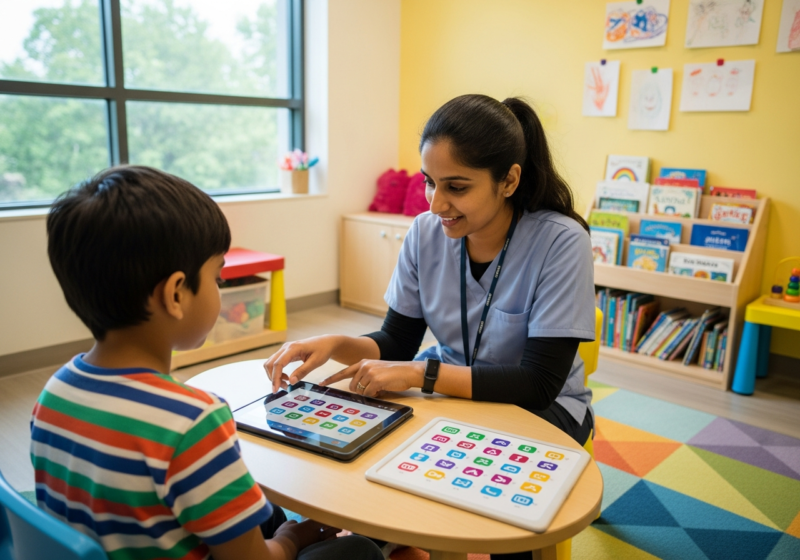
Augmentative and Alternative Communication (AAC) Support Services: Giving Every Child a Voice
Introduction
Some children with ADHD and autism struggle to express their needs using spoken language alone. However, difficulty with speech does not mean a lack of understanding or intelligence. As a result, Augmentative and Alternative Communication (AAC) becomes a powerful tool to support expression and participation. At the Best ADHD and Autism Center in Pune, AAC support services help children communicate effectively, reduce frustration, and engage confidently in daily life.
What Are AAC Support Services?
AAC support services use tools and strategies that assist or replace spoken communication. Rather than forcing speech, AAC focuses on enabling communication in the most accessible way for the child.
AAC may include:
- Picture Exchange Communication Systems (PECS)
- Communication boards or books
- Speech-generating devices
- Tablet-based communication apps
- Gesture and symbol-based systems
These tools are selected based on the child’s abilities, preferences, and developmental level.
Why AAC Is Important for Children With ADHD and Autism
When children cannot communicate their needs, frustration often builds. Because of this, behavior challenges and emotional distress may increase. AAC provides an immediate way for children to express choices, needs, and emotions—supporting learning and social interaction.
Importantly, AAC does not prevent speech development. In contrast, it often encourages language growth by reducing pressure and anxiety.
Key Benefits of AAC Support Services
1. Improves Functional Communication
Firstly, children learn how to express basic needs, preferences, and feelings. As a result, daily interactions become smoother.
2. Reduces Frustration and Behavioral Challenges
Secondly, when children can communicate effectively, emotional outbursts often decrease.
3. Encourages Social Interaction
Additionally, AAC helps children participate in conversations, classroom activities, and play with peers.
4. Builds Confidence and Independence
Meanwhile, successful communication boosts self-confidence and independence.
5. Supports Speech and Language Development
Most importantly, AAC complements speech therapy by strengthening language understanding and expression.
How AAC Support Services Are Delivered
AAC intervention begins with a detailed communication assessment. At the same time, therapists evaluate motor skills, attention span, and sensory preferences. A personalized AAC system is then introduced gradually, with regular training for both the child and caregivers.
AAC services often work best when coordinated with pragmatic language therapy to strengthen real-life communication skills.
Parent and Caregiver Involvement
Parents are trained to use AAC tools consistently at home. Because of this, children experience continuity across therapy, home, and school environments—leading to faster progress.
Why Early AAC Support Matters
Delaying communication support can limit social and emotional development. In contrast, early AAC intervention empowers children to communicate effectively during critical developmental stages.
Final Thoughts
In conclusion, Augmentative and Alternative Communication support services provide children with ADHD and autism a reliable, respectful way to express themselves. The Best ADHD and Autism Center in Pune offers structured AAC programs that focus on communication, confidence, and participation—ensuring every child has a voice.
