
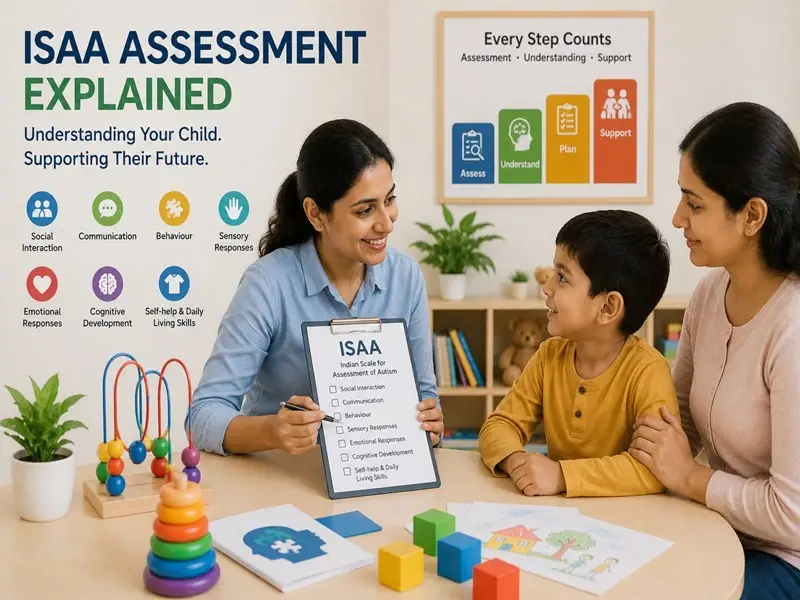
ISAA Test for Autism: Meaning, Score & Full Form
ISAA test for autism: ISAA stands for Indian Scale for Assessment of Autism, an assessment tool used in India to understand autism-related characteristics in children.
At Neuro Revolution International, the ISAA test for autism is one of the clinical assessments offered to understand a child’s developmental profile and establish a baseline for personalized intervention planning. When parents notice differences in their child’s communication, social interaction, behaviour, or development, an autism assessment can help provide clarity. One such assessment used for evaluating autism-related characteristics in Indian children is the Indian Scale for Assessment of Autism (ISAA).
What Is the ISAA Test for Autism?
The Indian Scale for Assessment of Autism (ISAA) is an assessment tool designed specifically for the Indian population. It evaluates different areas of a child’s functioning that may be associated with autism-related characteristics.
The assessment can provide structured information that helps professionals understand the child’s current strengths and challenges.
What Does the ISAA Assess?
The assessment looks at different areas of development, which may include:
Social interaction
Communication
Behaviour
Sensory responses
Emotional responses
Cognitive development
Self-help and daily living skills
Looking at multiple areas helps create a broader picture of the child’s development rather than focusing on one behaviour alone.
What Can Parents Expect During the Evaluation?
Parents may be asked questions about their child’s developmental history, communication, behaviour, social interaction, and everyday activities.
The professional may also observe the child’s responses and behaviour during the assessment. Information provided by parents and caregivers can be valuable because some behaviours may be more noticeable at home or in familiar environments.
The assessment process may vary depending on the child’s age and individual needs.
Is ISAA the Same as a Diagnosis?
An assessment tool should not be viewed in isolation. The ISAA provides structured information about autism-related characteristics, but a qualified professional should consider the child’s developmental history, observations, and other relevant information when understanding their overall profile.
Parents should discuss the results with the assessing professional to understand what they mean for their child.
Why Is Early Assessment Important?
A developmental assessment can help parents understand areas where their child may need additional support. At NRI, clinical assessments are used to establish a developmental baseline that can support individualized intervention planning and progress monitoring.
Early understanding can also help families make more informed decisions about appropriate developmental support.
How Should Parents Prepare?
Parents can make the process easier by:
Sharing relevant developmental history
Bringing previous assessment or therapy reports
Describing concerns honestly
Sharing observations from home or school
Allowing the child to respond naturally
Asking questions about the assessment results
There is no need to coach a child to give specific answers before an assessment.
Choosing the Right Professional Support
When looking for autism support in Pune, consider the center’s assessment methods, the qualifications of its professionals, how individualized their intervention plans are, and how they track progress over time.
For children experiencing attention or behavioral concerns, appropriate screening and a personalized intervention plan matter just as much as the initial diagnosis.
If you’re evaluating a child psychologist in the Hadapsar area, look at their professional qualifications, experience working with children, assessment methods, and how clearly they communicate with parents.
Conclusion
The ISAA can provide valuable structured information about a child’s social, communication, behavioural, sensory, and developmental functioning. However, understanding a child requires more than a single assessment score.
With professional evaluation, parent involvement, and individualized planning, families can gain a clearer understanding of their child’s needs and take informed steps toward appropriate developmental support.